
Calibration laboratories working with the Fluke 9640A RF Reference Source often need to verify the stability of the unit’s internal time base to ensure measurements remain traceable and within specification.
Proper verification requires more than simply measuring the 10 MHz reference output. The measurement system must also demonstrate sufficient accuracy, resolution, and uncertainty performance to reliably confirm the manufacturer’s specification.
This example project demonstrates how a complete measurement uncertainty analysis can support the verification of the 9640A internal time-base stability.
Why This Matters
RF reference sources like the 9640A are commonly used to support calibration of oscilloscopes and other high-frequency measurement equipment. The accuracy of these systems depends heavily on the stability of the internal reference oscillator.
Without a properly defined measurement method and uncertainty model, it can be difficult to demonstrate that the verification process itself is capable of confirming the specification.
A well-developed uncertainty analysis helps laboratories:
- Confirm their measurement system has sufficient capability
- Support ISO/IEC 17025 uncertainty documentation
- Validate performance verification procedures
- Provide defensible technical justification during audits
Example Verification Method
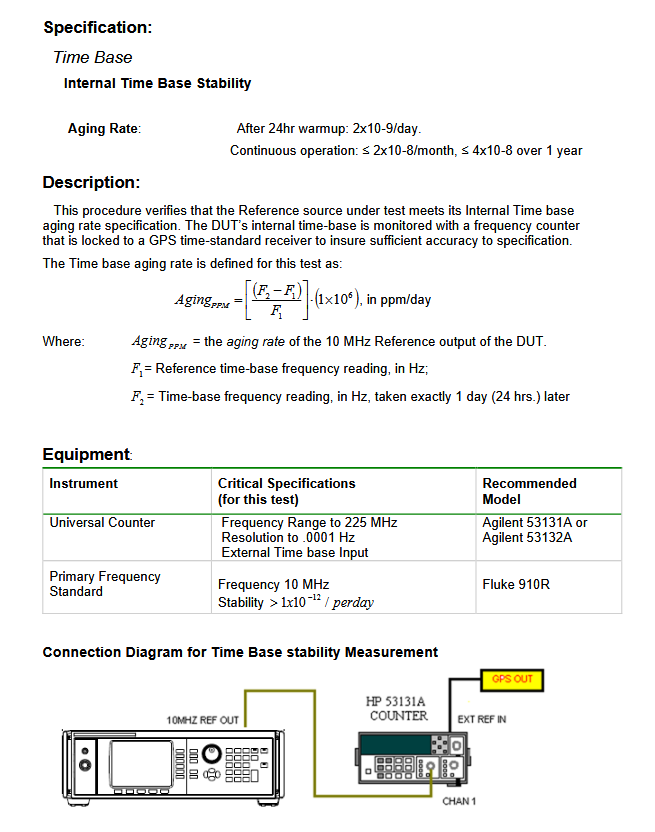
In this example procedure, the 10 MHz reference output of the 9640A is monitored using a high-resolution frequency counter referenced to a GPS-disciplined frequency standard.
Two measurements are taken 24 hours apart, allowing the daily aging rate of the internal time base to be calculated and compared against the published specification. Fluke 9640A Time base stability
The uncertainty analysis evaluates the performance of the measurement system, including factors such as:
- frequency counter resolution
- time-base reference accuracy
- trigger timing effects
- measurement gate time
This ensures the verification method has sufficient sensitivity to detect changes in the reference oscillator stability.
Supporting Calibration Automation
Clear uncertainty models are also valuable when developing automated performance verification systems.
Well-defined measurement equations and uncertainty contributors make it easier to design reliable test algorithms that truly verify instrument specifications.
This approach has been used to support both manual verification procedures and automated calibration systems.
Example Technical Paper
The full analysis includes the measurement model, uncertainty propagation, and validation of the measurement system capability.
📄 Download the Technical Paper:
Fluke 9640A Internal Time-Base Stability Verification
Need Help Developing Uncertainty Documentation?
If your laboratory is developing new calibration capabilities, building automation, or strengthening uncertainty documentation for accreditation, professional uncertainty analysis can help ensure your measurement processes are technically sound and audit-ready.